
Quick answer: a hydraulic scissor car lift is a vehicle lift whose platform is raised and lowered by one or more hydraulic cylinders pushing a set of crossed, folding steel arms. When the pump pressurises the cylinder, the arms unfold and lift the platform with the vehicle on it; mechanical safety locks hold it at height, so the hydraulic pressure is never relied on to keep the car up. Because the whole structure sits low and needs no overhead columns, scissor lifts are the most space-efficient lift type for tire shops, quick-service workshops, inspection centers and automated parking systems.
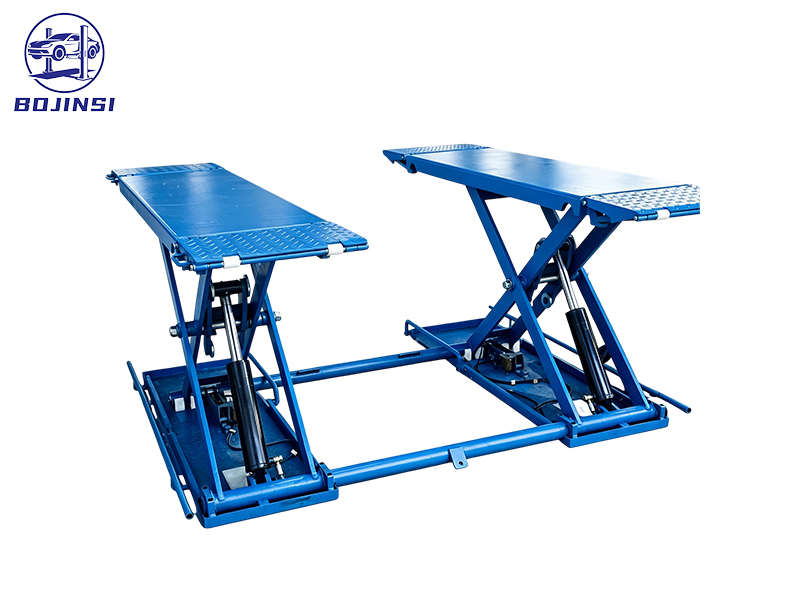
This guide is written for workshop owners, equipment purchasers and garage builders who are comparing lifting equipment. It covers the working principle in detail, the differences between mid-rise, full-rise, low-profile and alignment scissor lifts, the specifications that actually matter when you compare quotes, the safety standards a compliant lift must meet, a realistic maintenance schedule, and a step-by-step buyer's checklist you can use before signing a purchase order. Everything here is based on how these machines are built and used in daily workshop operation, not on marketing copy.
A hydraulic scissor car lift (also called a scissor lift table for vehicles, or a quick lift in its mid-rise form) is a lifting machine that elevates a vehicle between two horizontal platforms connected by a pantograph mechanism — the crossed "scissor" arms that give the lift its name. Unlike two-post lifts, which hang the car from swing arms on columns, or four-post lifts, which park the car on long runways, a scissor lift supports the vehicle on flat platforms. The vehicle never needs to be positioned on lifting pads or arms, which makes it faster to drive on and off.
The scissor arm set converts the horizontal thrust of the hydraulic cylinder into vertical movement. This is a key engineering advantage: a relatively short cylinder stroke can produce a tall lifting height, and the load stays centered over the platform instead of being cantilevered off columns. The result is a very stable platform with excellent side access — the technician can walk completely around the vehicle and reach all four wheels without obstruction.
Understanding the working cycle helps you judge build quality when you inspect a machine or evaluate a supplier's specification sheet. A full cycle has four stages.
The electric motor on the power unit drives a gear pump that pushes hydraulic oil into the cylinder(s). As the cylinder rod extends, it pushes the lower hinge of the scissor arms outward; the arms rotate and the upper platform rises. On twin-platform full-rise models, a flow divider or a shared torsion bar keeps both platforms moving at the same speed so the vehicle never tilts. A typical full-rise cycle time is 45–60 seconds, while a mid-rise quick lift reaches working height in 20–30 seconds.
This is the stage that separates a certified lift from a dangerous one. As the platform rises, spring-loaded pawls drop into a ladder of steel safety locks welded along the scissor arms or the frame. At working height, the operator lowers the lift a few millimetres so the pawls — not the hydraulic pressure — carry the full vehicle weight. Oil can then be relieved from the cylinder with zero load on the hydraulic circuit. A hose-burst valve in the cylinder line adds a second layer of protection: if a hose ever fails, the valve closes instantly and stops the platform from dropping.
With the vehicle resting on the mechanical locks, the technician performs the job: wheel and tire service, brake work, exhaust replacement, underbody inspection, lubrication or electrical checks. Full-rise models give roughly 1,450–1,900 mm of underbody clearance, enough for a technician to stand upright; mid-rise models give about 900–1,100 mm for tire and brake work at a comfortable height.
Lowering is controlled, gravity-fed descent: a solenoid or manual release valve lets oil flow back to the tank at a regulated speed, and the scissor arms fold in a smooth, damped motion. On better-built machines the descent speed stays constant regardless of vehicle weight because the valve meters the oil rather than free-falling. Pneumatic lock release, common on alignment-grade models, lets the operator disengage the safety pawls from the control console so the whole cycle is single-operator.
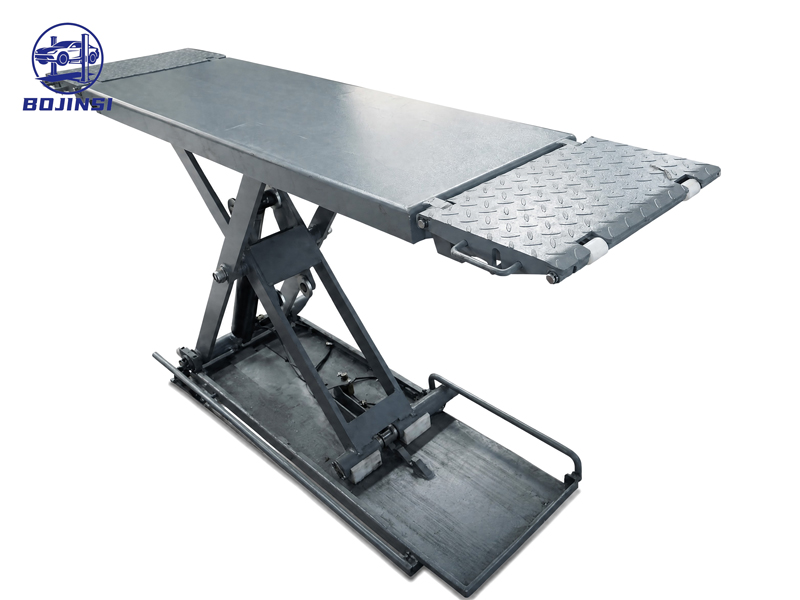
"Scissor lift" covers a family of machines with quite different jobs. Knowing which category a quote belongs to is the first step in comparing prices fairly.
Raises the vehicle 900–1,100 mm — high enough for wheels, brakes, and quick inspections — in 20–30 seconds. Capacities of 3,000–3,500 kg are typical. This is the workhorse of tire shops and quick-service bays, where a car comes in every 15–20 minutes and every second of cycle time counts.
Raises the vehicle to 1,450–1,900 mm so a technician can stand under it. Capacities from 3,000 to 5,500 kg cover passenger cars, SUVs and light commercial vehicles. Twin-platform (double-scissor) designs split the vehicle front/rear, which gives access to the sills and reduces the platform length needed in the bay.
Built for low-clearance vehicles. A low-profile platform collapses to 85–110 mm so sports cars can drive on without ramps; flush-mount versions are recessed into a pit so the collapsed platform is level with the floor. Flush-mount installation costs more (concrete cutting and pit steel), but leaves a completely flat working surface and is standard in high-end service centers.
A full-rise scissor lift with turntable pockets, slip-plate recesses and rear-sensor kits integrated into the platforms, used as the lift in a wheel-alignment bay. The platform surfaces are machined flat so alignment heads sit level at ride height.
A simplified, lower-cost version used to stack one car above another in parking systems. It trades working height for platform width and independent operation, and it usually runs on 220 V single-phase power.
Spec sheets are easy to inflate, so it helps to know which numbers are structural and which are cosmetic. The table below shows representative values for a standard full-rise double-platform scissor lift, followed by notes on each line.
| Specification | Typical Value | Why It Matters |
|---|---|---|
| Lifting capacity | 3,000–5,500 kg | Must cover your heaviest vehicle plus a 25–50% safety margin; EVs often weigh 2.0–2.6 t |
| Lifting height | 1,450–1,900 mm | Determines whether a technician can stand under the vehicle |
| Min. platform height | 85–330 mm | Low values allow sports cars on without ramps |
| Platform length / width | 1,400–2,000 mm / 550–700 mm (per platform) | Wheelbase coverage; too short limits SUVs and vans |
| Rising / falling time | 45–60 s up, 30–50 s down | Directly affects bay throughput in quick service |
| Motor power | 2.2–3.0 kW | Matches your shop supply (220 V single-phase or 380/400 V three-phase) |
| Hydraulic oil volume | 8–16 L (ISO VG46) | Cold-climate shops need the correct viscosity grade |
| Air supply (pneumatic lock release) | 6–8 bar | Required for single-operator lowering on alignment models |
| Concrete requirement | ≥150–200 mm, C25/C30, cured 28 days | Anchors must pull out of weak slabs long before the lift is overloaded |
| Net weight | 900–2,200 kg | Heavier frames generally mean more steel in the arms and locks |
Two numbers deserve special attention. First, lifting capacity should always be quoted against a real vehicle list: a 3,000 kg lift is enough for most sedans, but a shop that services electric SUVs should step up to 4,000–4,500 kg because EV battery packs push curb weights up sharply. Second, minimum collapsed height decides which cars can drive onto the platform; ask for the measured value, not the catalogue value, and add the ramp length to your bay layout before you commit.
Tire shops and quick-service bays: mid-rise Quick Lifts dominate because of the 20–30 second rise time and full wheel access.
General repair workshops: full-rise double-platform lifts handle brakes, suspensions, exhausts and underbody repairs.
Vehicle inspection centers: stable, column-free platforms let inspectors walk around the vehicle and photograph the underbody freely.
Car wash and detailing: flush-mounted low-profile lifts raise the car for underbody cleaning without cluttering the bay.
Home garages: single-platform mid-rise lifts running on standard household power bring professional capability into a two-car garage.
Automated and mechanical parking systems: parking-grade scissor platforms move vehicles between levels where ramps are impossible.
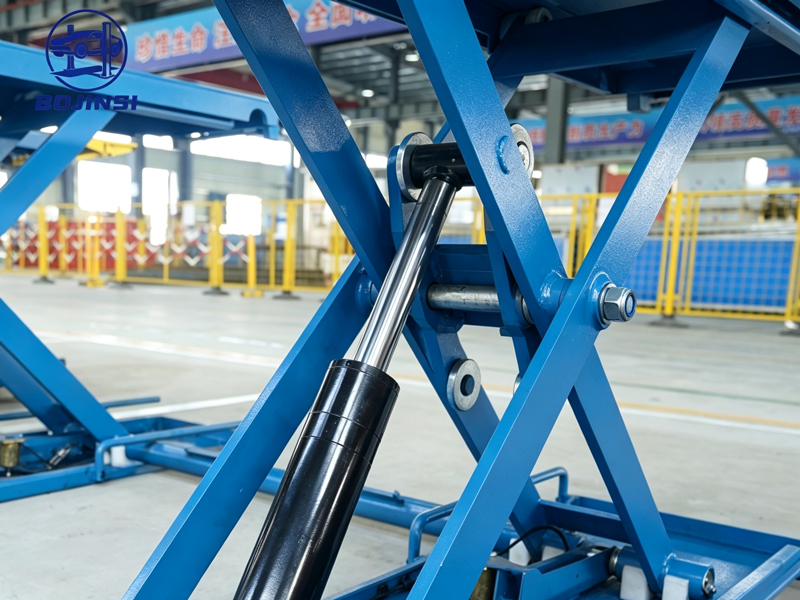
A compliant scissor lift is a chain of redundant protections, and every one of them should appear on your pre-shipment inspection checklist:
Mechanical safety locks (ladder locks): steel pawls engaged at every working height; the hydraulic system holds the car only while it is moving.
Hose-burst / velocity fuse valves: fitted directly in the cylinder port, they stop the load if a hose fails.
Flow divider or torsion bar synchronization: keeps twin platforms level within a few millimetres.
Limit switches: upper limit stops over-travel; some models add a safety bar under the platform that reverses descent on contact.
Manual emergency lowering: a valve that lets the lift descend slowly during a power cut — test it on delivery day.
Dead-man controls: up/down buttons that return to neutral automatically, plus an emergency stop.
Anti-slip platform surfaces and approach ramps.
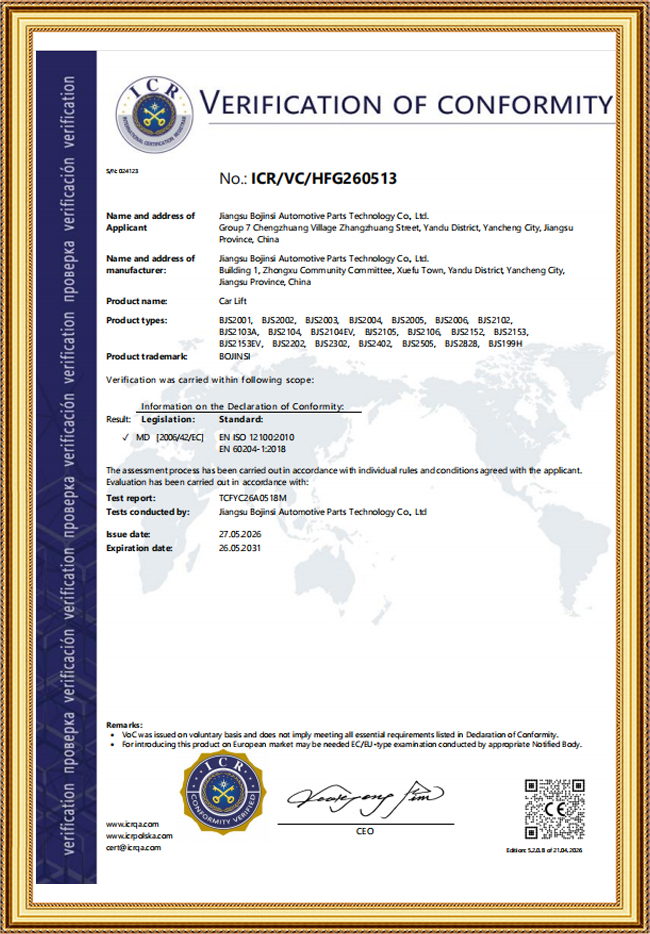
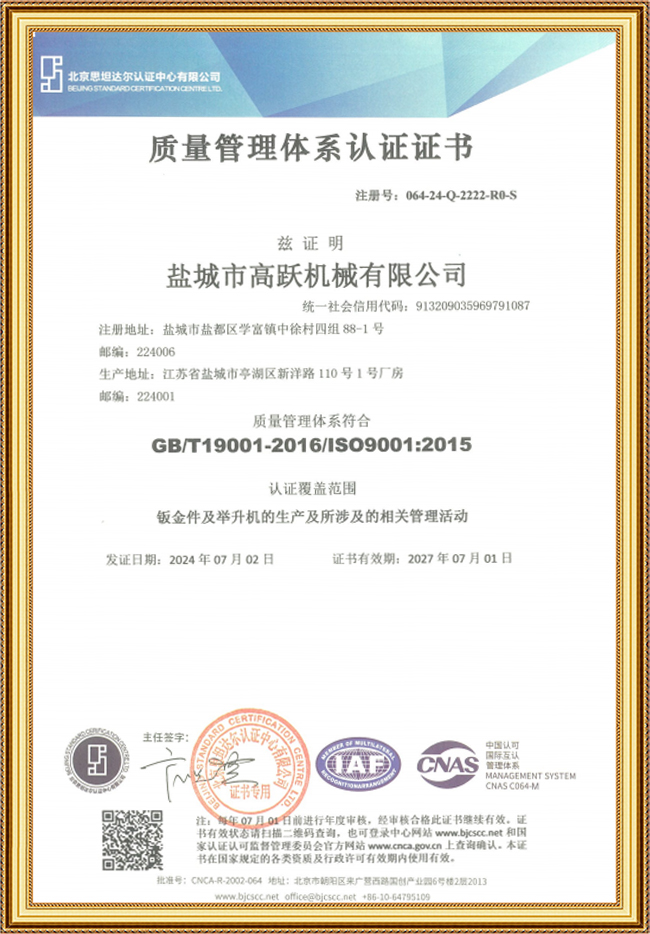
For Europe, the reference framework is the Machinery Directive 2006/42/EC with the EN 1493 vehicle lift standard; a notified-body certificate and a CE declaration are the paperwork trail. For other markets, ask which standard the design was tested against and request the test reports, not just the logo. Certificates issued for a product family should match the model number on your quotation — mismatches are a common red flag when buying imported equipment.
Surface mounting bolts the lift to the existing slab. It is cheaper and faster (typically one working day for two installers), but the collapsed platform stays 100–330 mm above the floor, so low vehicles need ramps. Flush mounting requires cutting a pit, adding rebar and drain provision, and letting the concrete cure again; it delivers a flat floor, which is why inspection bays and showrooms prefer it. Whichever you choose, the sub-floor matters more than the lift: anchors need sound concrete of at least 150–200 mm thickness and C25/C30 strength, cured a minimum of 28 days before torqueing.
Power and air requirements are modest — a 2.2–3.0 kW motor on 220 V single-phase or 380 V three-phase, plus a 6–8 bar air line for pneumatic lock release. Plan the power-unit position so the technician can hear the motor but cannot drive over the hose.
Scissor lifts are mechanically simple, and most failures found in service come from neglect of three things: oil, pivots, and locks. A realistic schedule for a shop doing 10–20 lifts per day looks like this:
| Interval | Task |
|---|---|
| Daily | Visual check of platforms, ramps and locks; listen for abnormal noise; confirm smooth descent |
| Weekly | Check hydraulic oil level with platforms down; inspect hoses for rubbing or weeping; clean platform surface |
| Monthly | Grease all pivot pins; verify synchronization; test emergency stop and manual lowering; torque-check anchor bolts |
| Quarterly | Inspect safety-lock pawls and ladders for wear; check cylinder rod for scoring; verify descent speed still damped |
| Every 1–2 years | Replace hydraulic oil and return filter; pressure-test relief valve setting; full lock engagement test at full load if possible |
Hydraulic oil choice matters more than most buyers realise: ISO VG46 suits most climate-controlled shops, while cold sites (below −10 °C) need a lower viscosity grade or the lift will crawl on winter mornings. Water contamination — visible as milky oil in the sight glass — should trigger an immediate oil change because emulsified oil destroys pump vanes quickly.
Buyers rarely need just one number; they need to match lift geometry to their services. The honest comparison looks like this:
| Aspect | Scissor Lift | Two-Post Lift | Four-Post Lift |
|---|---|---|---|
| Vehicle positioning | Drive onto flat platforms — fastest | Must find lifting points on sills — slowest | Drive on runways — fast |
| Floor space needed | Least; no columns, walk-around access | Column footprints at both sides | Largest (3.5–5 m runways) |
| Wheel-off work | Excellent | Excellent | Needs rolling jacks |
| Wheel alignment | Only alignment-grade models | With alignment kits | Natural fit |
| Installation depth | Flush-mount needs a pit; surface-mount none | None | None |
| Ceiling height needed | Lowest — ideal for basements | High (3.6–4.2 m) | High |
| Typical best use | Tire shops, inspection, detailing, parking | General mechanical repair | Storage, alignment, long-term service |
If your bay has a low ceiling, high daily vehicle turnover and mostly wheel/brake work, the scissor lift wins on nearly every line. If you do engine and transmission removals, a two-post lift's open underside is still the better tool — which is why many full-service workshops run both types side by side.
Heaviest vehicle? List the top three vehicles by weight you will actually lift, add 25–50% margin, and buy to that number.
Which type? Mid-rise, full-rise, low-profile, alignment or parking — match the category to your service list, not to the brochure photo.
Measured collapsed height? Ask for the number with ramps removed if you serve low cars.
Safety locks at every position? Confirm pawls engage continuously, not at two or three discrete heights.
Hose-burst valves standard? Both platforms, fitted at the cylinder port.
Synchronization method? Flow divider or torsion bar — and what is the guaranteed level tolerance?
Certificate chain? CE / EN 1493 (or local equivalent) with the exact model number on the report.
Power unit quality? Known-brand motor and pump, or at least a spare-parts commitment with part numbers in the manual.
Concrete on site? Measure slab thickness and get the anchor specification before ordering.
Spares and wear parts? Oil, filters, pawls, hoses, ramp rubber — confirm 5–10 years availability and prices.
Packaging and shipping? Iron frame + plywood for sea freight; confirm forklift unloading at your site.
Commissioning support? Remote video guidance at minimum; on-site service for multi-bay installations.
Purchase price is only one line in the ROI calculation. A quick-lift scissor in a tire bay typically pays for itself through throughput: saving even 90 seconds per car on 25 cars a day adds up to roughly one extra job per day, which over a year exceeds the machine's cost in most markets. Add the bay-space saving (a scissor lift leaves the bay floor clear of columns, so the same bay can double as a detailing or parking space), lower installation cost than a flush two-post, and minimal consumables (hydraulic oil and grease only), and the total cost of ownership is usually the lowest of the three lift types for wheel-centric service businesses.
On the other hand, do not buy on price alone: the difference between a 2,000 kg rated arm set and a properly certified 4,000 kg one is mostly steel and lock machining — the parts you cannot see after the paint dries. A lift is one of the few workshop purchases where the failure mode is a dropped vehicle, so the quality premium is, bluntly, insurance.
Standard full-rise models reach 1,450–1,900 mm. Special multi-stage scissor designs for parking systems can go higher, but workshop lifts stay in that range because it is the practical height for a technician to work standing.
Choose at least 4,000 kg. Popular electric SUVs weigh 2.0–2.6 t, and battery packs concentrate the mass between the axles, which loads the platform center. A lift rated 4,000–4,500 kg with a stiff center cross-shaft is the safe choice.
Yes — this is one of its strongest use cases. Because there are no overhead columns, a scissor lift needs only enough headroom for the raised vehicle plus a little clearance, which makes it ideal for basements where a two-post lift would not fit.
Hydraulic pressure is for motion; steel locks are for holding. Seals, hoses and valves can all fail in ways that would let a loaded cylinder drift down. Certified designs lower the vehicle onto mechanical pawls before any work starts, so the hydraulic circuit carries no static load.
With the maintenance schedule above, 10–15 years of commercial use is normal. The usual life-limiting parts are hoses (replace every 5 years or on any sign of crazing), pivot bushings, and the power unit — all of which are replaceable.
Only alignment-grade scissor lifts with machined turntable and slip-plate pockets. A standard scissor lift has no provision for the alignment heads and its platform tolerance is wider than alignment work allows.
Mid-rise and most single-platform models run on 220 V single-phase with a 2.2 kW motor. Large full-rise double-platform models usually want 380/400 V three-phase, though single-phase versions exist at slower cycle times.
Check the oil weekly, replace it every 1–2 years, grease the pivots monthly, and inspect hoses quarterly. Contamination and neglected pivots cause the vast majority of service calls.
Yes, when it carries proper safety locks, hose-burst valves and CE/EN 1493 certification, and when operators use the locks as designed. The failure modes people worry about are all addressed by the lock ladder and the burst valve.
Ask for the CE declaration of conformity and the notified-body test report, check that the report's model number matches your order, and confirm the issuing body is genuine. Reputable manufacturers send these documents without hesitation.
A hydraulic scissor car lift is the most space-efficient way to raise vehicles for wheel work, inspection and underbody service. Judge any offer on four things: the steel in the scissor arms and lock ladders, the redundancy of the safety chain, the honesty of the measured specifications, and the certificate trail behind the CE mark. If those four check out and the geometry matches your services, a scissor lift will likely be the highest-throughput machine in your workshop.
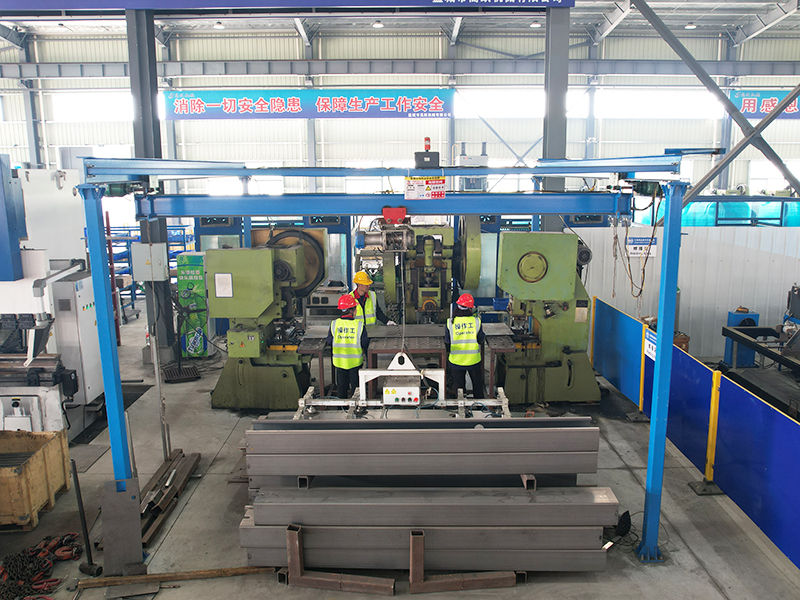
As a China-based manufacturer of scissor car lifts, quick lifts, two-post lifts and parking systems, we supply CE-certified equipment to workshops, tire shops and parking projects worldwide, with full pre-shipment inspection documentation, spare-part support and remote commissioning guidance. Contact us for a specification review or a model recommendation matched to your vehicle list and bay layout.

Fundada con un compromiso con la calidad y la innovación, BOJINSI Lift es un fabricante profesional especializado en equipos de elevación para automóviles y soluciones de estacionamiento. Con más de 15 años de experiencia en producción y exportación, hemos construido una sólida reputación como proveedor confiable para clientes de todo el mundo.
WhatsApp: +86 15295312418
Correo electrónico:jacky@bojinsilift.com
agregar: grupo 7 Pueblo Chengzhuang Calle Zhangzhuang, distrito de Y'andu, ciudad de Y'an, provincia de Jiangsu, China


Copyright © 2025 Jiangsu Bojins Automotive Parts Technology Co., Ltd
Mapa del sitioEste sitio web utiliza cookies para garantizar que obtenga la mejor experiencia en nuestro sitio web.

 English
 Pусский
 العربية



 Teléfono
 E-mail
 mensaje
Comentario
(0)