
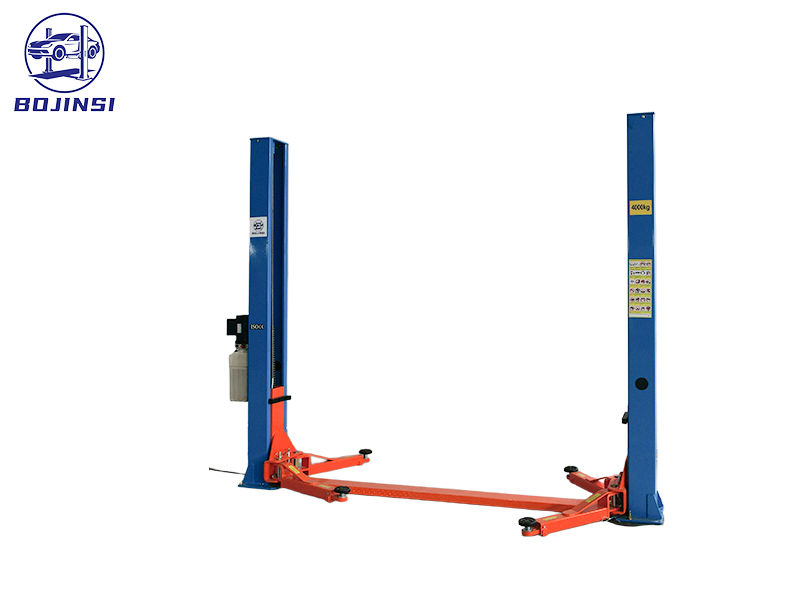
A 4 ton hydraulic 2 post car lift is a two-column vehicle hoist rated for 4,000 kg (8,800–9,000 lb) that raises cars, SUVs and light commercial vans with two hydraulic cylinders — one per column — driven by a 2.2–3.0 kW electric power unit working at roughly 16–20 MPa of oil pressure. A typical unit reaches a maximum lifting height of 1,800–1,900 mm in 45–60 seconds, lowers in 20–50 seconds, and holds the load on mechanical safety locks so the hydraulic system carries no static load while technicians work underneath. The two main configurations are the clear floor design (overhead crossbeam, unobstructed floor between columns) and the floor plate or baseplate design (no overhead bar, needs only about 2,742–2,860 mm of ceiling clearance). For a buyer, the three decisions that matter most are: which configuration fits your ceiling height, whether your concrete slab meets the anchoring specification (typically 120–150 mm of C25/3,000 psi concrete or better), and which lock release system — single-point, dual-point manual, or pneumatic — your technicians will use dozens of times per day.
Understanding the mechanics behind a 4 Ton Hydraulic 2 Post Car Lift helps buyers compare quotations intelligently instead of only comparing prices. Every major subsystem plays a distinct role in how safely and smoothly 4,000 kg rises off the shop floor.
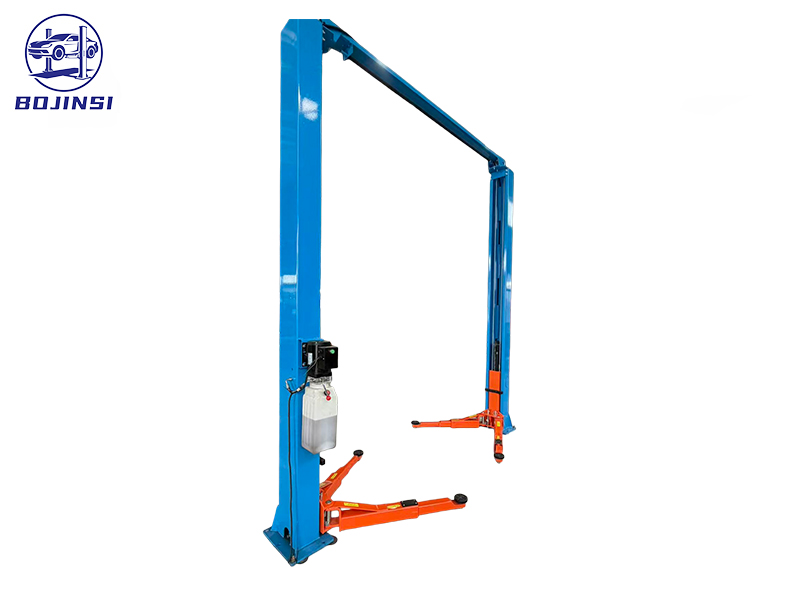
Each column houses a hydraulic cylinder. When the operator presses the UP button on the 24V low-voltage control box, the power unit — a 2.2 kW to 3.0 HP motor driving a gear pump — pushes hydraulic oil into both cylinders simultaneously. Working oil pressure typically sits around 16–18 MPa (roughly 2,300–2,600 psi), and the reservoir holds 10–14 liters of AW46 or equivalent hydraulic fluid. A parachute valve (hose-burst valve) fitted at the cylinder port instantly blocks oil flow if a hose ruptures, which is why a cylinder cannot free-fall even in a worst-case hose failure. A travel limit switch at the top of each cylinder stops the motor automatically at full rise, protecting the cylinder from bottoming out and extending its service life.
Because two separate cylinders lift the two carriages, the system must force both sides to rise at identical speed — otherwise the vehicle tilts and can slide off the pads. Three engineering approaches dominate the market. The first is chain-driven cylinders, where a heavy-duty chain over a sprocket couples carriage movement to cylinder travel; this is the time-proven design on most baseplate units. The second is the steel wire-rope equalization system, which ties both carriages together so a synchronous movement is mechanically enforced and the vehicle is prevented from tilting. The third is dual direct-drive cylinders with aircraft-grade synchronization cables, common on premium clear floor models, which eliminate chain stretch and reduce noise to 70–75 dB. In all three cases, equalization cables should be checked and re-tensioned during routine maintenance, because a stretched cable is the most common cause of uneven lifting.
Once the carriage reaches working height, toothed safety locks (ratchets or ladder bars) engage automatically every 50–100 mm of travel. The load then rests on steel locks, not on hydraulics — this is the single most important safety principle of any two post lift. Lock release comes in three variants. Dual-point manual release requires the operator to pull a cable on each column before lowering, which is slower but foolproof in a specific way: the technician physically walks to both sides of the vehicle. Single-point manual release disengages both columns simultaneously from one side, saving 15–20 seconds per cycle and eliminating the risk that an operator forgets one side. Pneumatic single-point release goes further and locks the lift at any height, not just at fixed lock positions. Buyers comparing quotes should treat the lock release system as a primary differentiator, not an accessory.
Four telescoping swing arms — usually three-stage on 4 ton models — reach from 800 mm to about 1,200 mm front and rear, letting the pads meet the manufacturer's lifting points on sedans, SUVs and pickups. Automatic arm restraints (steel gear-and-pinion or spring-loaded) lock each arm in position the moment the lift leaves the floor, so an arm cannot swing while the vehicle is airborne. Double-screw rubber pads with a 50 mm pin diameter are standard, and 75–150 mm pad extensions handle running boards and pickup truck frames. Maximum load per arm on a 4 ton lift is typically 1,000–1,020 kg, which is why correct pad placement under the vehicle's designated lift points matters as much as the total capacity figure.
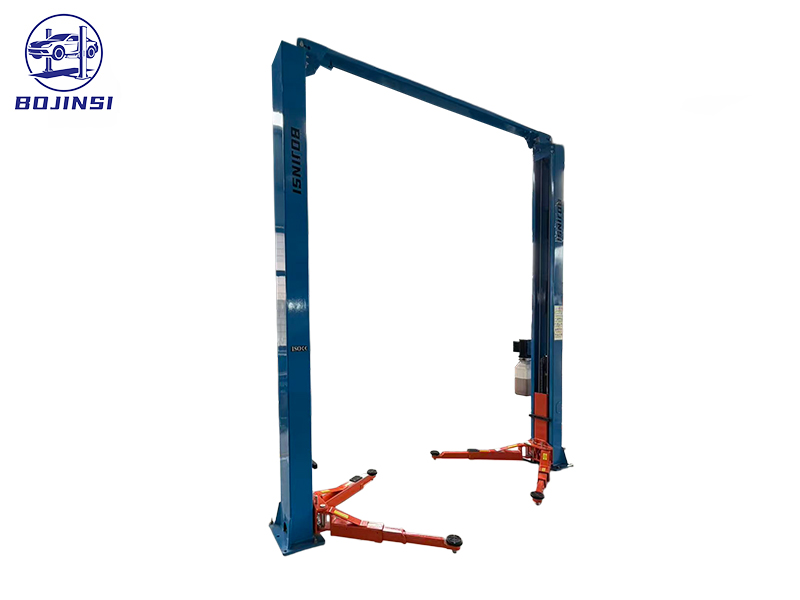
The 4 ton two post segment splits into four practical configurations. The differences determine ceiling requirements, workflow and price, so buyers should match the type to the building rather than to the brochure.
| Type | Overall Height | Min. Ceiling Needed | Floor Between Columns | Best For | Watch Out For |
|---|---|---|---|---|---|
| Clear floor (overhead beam) | 3,635–3,835 mm | 3,700–4,000 mm | Unobstructed | General repair, oil changes, brake and exhaust work | Needs high ceiling; overhead bar limits tall vans |
| Floor plate / baseplate | 2,742–2,860 mm | 2,900–3,100 mm | Low plate across floor | Low-ceiling workshops, tire shops, quick lube bays | Plate on the floor restricts rolling jacks and creepers |
| Symmetrical | 3,377–3,800 mm | 3,400–4,000 mm | Depends on design | Pickups and vans with front-heavy weight distribution | Car doors open near the column; less driver-side clearance |
| Asymmetrical | 3,635–3,835 mm | 3,700–4,000 mm | Unobstructed or plate | Sedans — columns set back 30°, doors open fully without hitting steel | Slightly less suited to long-wheelbase light trucks |
Most export orders from Chinese manufacturers fall into the clear floor and baseplate categories, and many models offer two standard column height settings or optional height extension kits that raise overall height from roughly 3,820 mm to 4,430 mm. Width extension kits that widen the space between columns from 2,850 mm to 3,000 mm are also available and are worth ordering for shops that regularly lift wide-body SUVs.
Specification sheets for 4 ton hydraulic 2 post car lifts look similar at a glance, but the numbers below are the ones that actually decide whether a unit fits your building and your workflow. Use this table as a cross-check against any quotation.
| Specification | Typical Range (4 Ton Class) | What to Confirm |
|---|---|---|
| Lifting capacity | 4,000 kg (8,800–9,000 lb) | 115% dynamic and 150% static test certification |
| Max lifting height | 1,800–1,900 mm | Height with 75 mm pad extension adapters included |
| Min pad height | 90–115 mm | Lowest pickup point for lowered sports cars |
| Lifting time | 37–60 s | Rated at full 4,000 kg load, not empty |
| Lowering time | 20–60 s | Controlled descent speed, not free-fall |
| Motor power | 2.2 kW / 3.0 HP | Available voltage: 220V single phase or 380V three phase |
| Working oil pressure | 16–18 MPa | Hose rating and parachute valve presence |
| Oil tank capacity | 10–14 liters | Oil type (AW46 or equivalent) for cold climates |
| Drive-through width | 2,486–2,554 mm | Widest vehicle your shop will admit |
| Width between columns | 2,560–2,860 mm | Door swing clearance on both sides |
| Overall weight | 599–682 kg | Freight class and unloading equipment at your dock |
| Noise level | ≤70–75 dB | Relevant for workshops adjacent to offices |
| Container loading | 25 units / 20' GP | Packaging dimensions for importing several bays at once |
One frequently overlooked number is gross weight. A 4 ton two post lift ships at roughly 600–680 kg across two or three crates measuring about 2,910 × 450 × 1,525 mm per pair, so plan forklift access and a second pair of hands before the truck arrives, not after.
More 4 ton two post lift problems trace back to the floor than to the hydraulics. The columns transfer the entire 4,000 kg load plus dynamic shock into eight or more anchor bolts, and a weak slab will crack around those bolts within months.
Mainstream manufacturers require a concrete slab of at least 120–150 mm thickness with a compressive strength of C25 or higher (about 3,000 psi), and some installation guides specify up to 300–500 mm for older or doubtful floors. The critical rule is uniform, monolithic concrete: the slab must be a single continuous pour without expansion joints, wire chases or drainage channels running under either column. Fresh concrete needs a minimum curing time of 7 days before drilling, and 28 days is the safe standard. If your building sits on a floating slab or you cannot verify its thickness, core-drill a test hole at each planned column location before ordering the lift.
Each column is fixed with dedicated anchor bolts — typically M16 wedge anchors — torqued to the manufacturer's specification, with embedment depth around 90–110 mm. Columns must sit within about 1–2° of vertical; shims are supplied for levelling on imperfect floors. Column spacing defines the lifting envelope: the width between columns of 2,560–2,860 mm sets the drive-through clearance, and a minimum bay of roughly 4.4 m wide × 7.0 m long × 3.1–4.2 m high (depending on configuration) is the practical benchmark for one lift. Allow 0.5 m of side clearance beyond the overall width of 3.35–3.44 m so doors can open and technicians can walk around the vehicle.
The standard power unit accepts 220V single phase or 380–415V three phase at 50/60 Hz. A 2.2 kW motor draws a modest starting current, so a dedicated 16A circuit is normally sufficient, but the circuit must be properly grounded. The control box operates at 24V low voltage (usually IP54 rated) for operator safety, and the wiring from power unit to control box should be routed so a vehicle can never run over it. Installing buyers in regions with unstable grid power should ask the supplier about a manual lowering valve option, which allows safe descent during a blackout with the vehicle on the locks.
The 4 ton class is the volume workhorse of the global service industry because it covers nearly every vehicle a general workshop sees short of heavy trucks.
For workshops planning multiple bays, container economics matter: at roughly 25 units per 20' GP, a three-bay order is usually the sweet spot where per-unit freight cost drops meaningfully.
Certification is not paperwork theater — each standard encodes specific test loads and failure behaviors that determine how the lift behaves on the day something goes wrong.

Operator training is the last layer: the single most common accident in two post lift operation is incorrect pad placement on a vehicle with compromised rocker panels. A fifteen-minute induction covering lifting points, arm restraints and the rule that no one works under a vehicle not resting on locks prevents almost all of it.
A two post lift is mechanically simple, and a disciplined maintenance routine keeps one running 15–20 years. The schedule below consolidates manufacturer recommendations into a workshop-practical table.
| Interval | Task | Detail |
|---|---|---|
| Daily | Visual inspection | Check pads for wear and cracks, look for oil leaks at cylinder rods and hoses, confirm arms lock in place |
| Daily | Function check | Raise about 300 mm, engage locks, confirm both sides stop evenly before taking a vehicle to full height |
| Weekly | Lock mechanism check | Verify safety locks engage and release freely; look for debris or paint build-up in lock teeth |
| Weekly | Anchor bolt spot check | Confirm anchor nuts remain torqued; re-torque any that moved |
| Monthly | Cable tension | Check equalization cables and chains for stretch; re-tension per manual so both carriages rise level |
| Monthly | Hydraulic oil level | Top up AW46 or equivalent if below the sight-glass mark; inspect for foaming (air ingress) |
| Quarterly | Slide blocks and sliders | Inspect wear-resistant polyethylene slide blocks; replace when worn to about half thickness |
| Quarterly | Lubrication | Grease arm pivot pins, screw-pad threads and chain per manual points |
| Annually | Hydraulic oil change | Replace oil and tank filter; oil contaminated with water or metal particles accelerates pump wear |
| Annually | Full load test | Lift a certified test load (or the heaviest regular vehicle) and verify lift time, levelness and lock holding |
| Annually | Hose and seal inspection | Check oil pipes for abrasion against steel; replace seals showing weeping — quality oil seals typically last 3–5 years |
Keep a written log per bay. Buyers comparing suppliers should also weigh spare parts availability: wear items are slide blocks, pads, arm restraint gears, oil seals and cables, and a supplier who quotes a lifetime spare parts commitment with the machine is worth a few percent of price premium.
Use this checklist when comparing quotations for a 4 Ton Hydraulic 2 Post Car Lift. Every line is a question a first-time importer commonly discovers too late.
Yes, with two cautions. EV battery packs are heavy and located in the floor, so lifting points sit exactly at the pack edges — use the vehicle manufacturer's designated lifting points and rubber blocks, never the battery case itself. Second, EVs are quiet: verify pad contact before raising, because there is no engine noise cue. Capacity is not the issue — most EVs weigh 1,800–2,600 kg, well within 4,000 kg.
Add the lift height you actually use to the vehicle height. For a clear floor model at 3,635–3,835 mm overall, a 3,900–4,200 mm ceiling is comfortable. For a baseplate model at 2,742–2,860 mm, 3,000–3,100 mm works. Remember the vehicle adds height too: an SUV of 1,800 mm raised 1,850 mm needs about 3,650 mm plus clearance, which is why low-ceiling shops choose baseplate designs with 1,850 mm lifting height.
Yes. A 2.2 kW (3.0 HP) motor draws roughly 12–15 A at 220 V, well inside a 16 A circuit. Lifting time on single phase is within a few seconds of three phase. Three phase becomes relevant only when one power unit feeds additional equipment or when local grid voltage sags under load.
Two experienced technicians need one working day: unloading and uncrating (about 2 hours), column placement and anchor drilling (3–4 hours), arms, synchronization and power unit connection (2 hours), then a loaded commissioning test. Add a second day if the slab needs patching or if electrical circuits must be run first.
Hydraulics move the vehicle; locks hold it. The safety locks engage automatically every 50–100 mm, and once engaged the steel teeth carry the full 4,000 kg with no dependence on oil pressure, seals or hoses. Every under-vehicle task must be performed with the carriage resting on locks — the control system should make descent impossible until both locks release.
Machine cost varies by region and configuration; freight for a 600–680 kg crated pair typically adds a few hundred US dollars regionally and more for intercontinental shipping, depending on FOB, CIF or DDP terms. Installation by a local contractor commonly runs 4–8 labor hours. Budgeting buyers should therefore price the machine, the freight, and the first set of anchoring plus electrical work as one figure.
Baseplate wins below about 3,100 mm because its overall column height is 2,742–2,860 mm. Some clear floor models offer two height settings and extension kits, which narrows the gap — a low-setting clear floor at about 3,635 mm fits in a 3,700 mm bay. Choose baseplate when ceiling is truly tight; choose low-setting clear floor when you also want an unobstructed floor for jacks and carts.
Annually under daily commercial use, with a mid-year level and condition check. Use AW46 or the manufacturer-specified grade; in cold workshops below 5°C, ask about low-temperature oil. Contaminated oil is the leading cause of pump and seal failure and costs almost nothing to prevent.
Yes, that is the purpose of the class. The four three-stage arms with 800–1,200 mm reach cover sedan and SUV lifting points, and stackable 75–150 mm pad extensions handle pickup frames and running boards. Verify that the drive-through clearance of 2,486–2,554 mm accommodates the widest vehicle you intend to admit, and that the per-arm load of about 1,020 kg matches front-axle weights of your heaviest van.
A 4 ton hydraulic 2 post car lift is the highest-utilization piece of equipment most service bays will ever buy, and the specification that matters least is the one printed largest on the quotation — the capacity. Ceiling height, slab quality, lock release type, and the vendor's spare parts commitment decide whether the machine earns money for fifteen years or frustrates technicians for one. Buyers who measure the building first, verify the 115% and 150% test documentation, and order height and width kits with the initial shipment consistently report the smoothest ownership experience. For overseas procurement teams comparing factories, treat the answers to the twelve checklist items above as the real product: a 4,000 kg rating is a commodity, but disciplined certification, honest cycle times and a written spares program are not.


Fundada con un compromiso con la calidad y la innovación, BOJINSI Lift es un fabricante profesional especializado en equipos de elevación para automóviles y soluciones de estacionamiento. Con más de 15 años de experiencia en producción y exportación, hemos construido una sólida reputación como proveedor confiable para clientes de todo el mundo.
WhatsApp: +86 15295312418
Correo electrónico:jacky@bojinsilift.com
agregar: grupo 7 Pueblo Chengzhuang Calle Zhangzhuang, distrito de Y'andu, ciudad de Y'an, provincia de Jiangsu, China


Copyright © 2025 Jiangsu Bojins Automotive Parts Technology Co., Ltd
Mapa del sitioEste sitio web utiliza cookies para garantizar que obtenga la mejor experiencia en nuestro sitio web.

 English
 Pусский
 العربية



 Teléfono
 E-mail
 mensaje
Comentario
(0)